
How to Start a Journaling Practice (+35 Free Journal Prompts)
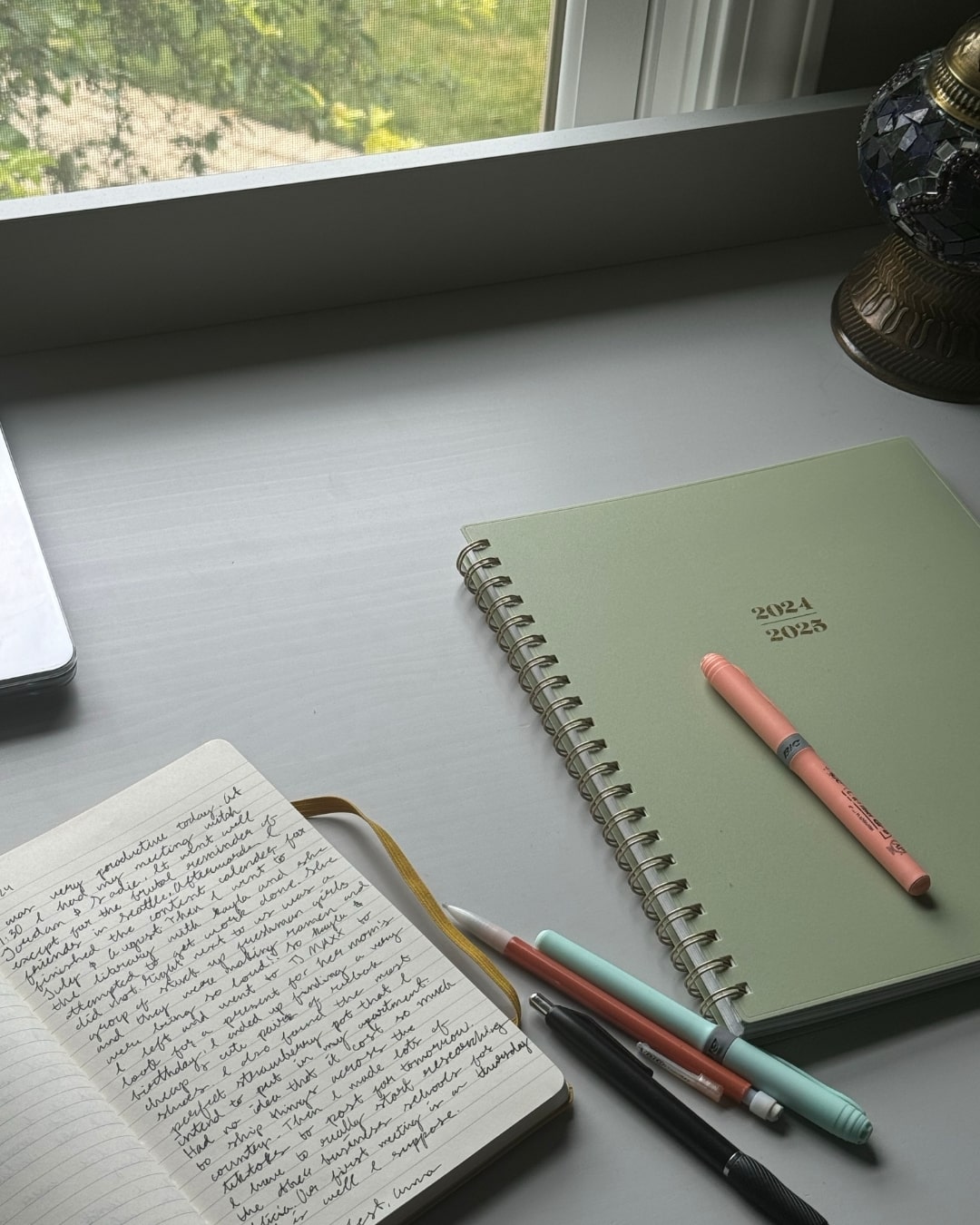
I was absolutely one of those teenagers who kept a “secret diary” in high school, recording everything from my secret crushes to my outpourings of frustration in typical teenage angst-ridden fashion. My journals from that time totally make me cringe today, but I am happy to have my personal reflections on growing up in the late nineties/early aughts.
While my journals today might look very different from what my 15-year-old self used to write (or maybe not, depending on the day!), one underlying thought binds it all — writing things down helps me process them better. Be it my emotions, my hopes, or even the mundane daily occurrences. It even makes me more mindful in my daily life.
To me, journaling helps make sense of it all. I try doing it in some manner almost every day, but I definitely find myself reaching for my journal(s) even more so in times of indecision or turmoil, because that’s when I need the unburdening the most.
All this to say, journaling holds a very special place in my life and in my heart. It has helped me work through some difficult days, and it also stands as a witness to some amazing days as well.
If you’re new to the world of journaling, it might feel a bit much, because while there is no right or wrong way to journal, there are definitely MANY ways to journal. I wanted to put together this primer for you all, so that you can cut through the overwhelm and hopefully start a journaling practice that will enrich your life.
Know Your Reason Why Before You Start Journaling
To derive the most out of your journaling practice, it’s important to dig a little deeper and find out your reason why. It will give you a sense of direction with your journal. Here are some of the potential reasons you may want to start a journal:
~ a record of your days
~ memory keeping
~ to track your habits or interests
~ to process your emotions
~ to work on your goals
~ to do a daily brain dump
~ as a form of creative expression
~ to capture your to-dos
~ for self-improvement
~ to deepen your spiritual practice
There’s no right or wrong answer to this. It could be just one of the above reasons, it could be a combination. Either way, it’s helpful to know for yourself why you’re starting a journal. And your reason why can (and probably will) evolve over time as well!
What Kind of Journal is Best Suited for You?
Depending on your reason why, you can narrow down the kind of journaling that works best for you, at least to start with. This is just a broad framework, but hopefully it will give you an idea about the various types of journals that you can use and create.
If you want a journal for recording your days or for memory keeping…
… try a regular journal (pen/paper OR digital app), or a dated diary, or scrapbooking in its myriad shapes and forms. I’ve maintained a “regular journal” for some years now, and for a couple of years in between, I also dabbled in pocket scrapbooking.
If you’re looking for a journal for creative expression…
… try creative journaling or art journaling. It’s exactly what it sounds like. Use embellishments and art supplies to decorate your journal and document your thoughts. Get Messy is an incredible resource if you want to get started with creative/art journaling.
If you want a journal to record your daily to-dos or tasks…
… a bullet journal or a dated diary would be the way to go. Bullet journaling uses visual icons (traditionally, bullets) to categorize entries and has its own syntax system.
If you want to journal for self-improvement (tracking habits or goals)…
… you could try a regular journal (pen/paper or digital app) with some templates in place, or a bullet journal. Bullet journaling has taken on a much broader meaning than when it was first introduced, with so many fancy tracking templates, and it’s now become a whole movement in journaling!
If you want to deconstruct your life and know yourself better…
… you could try guided journals or these journal prompts. Guided journals come with their own sets of prompts, which are especially helpful if you’re trying to dig deeper about yourself. Lots and lots of options with this, depending on what you’re looking to deep dive into. I’ve got a few suggestions on guided journals later in the post.
If you want to grow a specific interest…
… you could try a regular journal (pen/paper or digital app) or a journal meant specifically for that purpose. You can get dream journals, gratitude journals, wellness journals, tarot journals, and more. If you’re interested in deepening your spiritual practice, you can even explore Bible journaling.
I don’t mean to confuse you with all this, but to simply reassure you that there is something for everyone! Of course, you could only stick to just one journal and use it as a catch-all for everything you want to document, and then, as your interests grow, you can branch out to more specific journals.
What Supplies Do You Need to Start Journaling?
As you might have already gleaned from the previous section, just a notebook and a pen are good enough to get you started. That’s really it. Or if you’d prefer to go digital, then an app, or a document that you can update regularly.
Beyond that, depending on the specific type of journaling you would like to do, you can add more supplies, like highlighters, coloured pens, washi tape to begin with, and then, well, the sky is the limit.
How to Start Journaling
Choose a format to begin with
At the risk of repeating myself for the nth time, there is no right or wrong way to do this. Pen & paper vs. digital apps/websites — choose the format that you are most comfortable with. The key is to select a format that you will be most consistent with.
Set some time aside for journaling — It’s okay to start small
If you’re not used to pouring your heart out on a piece of paper, it may be difficult to get the words flowing the first few tries. So, start with maybe 5-10 minutes of journaling. Write down whatever comes to mind. It does not necessarily have to be a deep and profound — it just has to feel true to you.
Use Journal Prompts
If free-form journaling seems too intimidating to begin with, try out a guided journal or journal prompts (click here to receive a list of 35 journal prompts to get you started!). A guided journal or journal prompts will direct you to respond to a specific question, and it can be a helpful way to get into the habit of journaling.
Make a ritual out of it
Choose a time of the day when you are not rushed. Make a ritual out of it instead of making it seem like a chore. Journaling is supposed to enrich you, and in fact, it can definitely be a part of your self-care routine. It should not feel like yet another thing on your to-do list.
Be willing to open up
Journaling, in whichever form you practice, is meant to help you know yourself better. If you hold back from yourself, if you don’t allow yourself to be vulnerable, you may not quite benefit fully.
Be open to experimenting
If you’re just starting out and your first chosen journaling style doesn’t work for you, try something else. As you might have seen above, there are plenty of ways to journal — experiment till you find something that feels true to you.
Set some time aside to reflect on what you’ve written
The biggest benefit from journaling comes from reflecting on what you’ve written and making changes in your life, if necessary. Even if you’re just doing stream of consciousness writing, going over past entries can help you see patterns of behaviour or thought.
My Current Journaling Setup
Over the years, I’ve tried various forms of journaling — some which have stuck (simple pen & paper writing + journal prompts) and some which were just short-lived experiences (here’s looking at you, bullet journaling!). Here’s what works for me currently.
For day-to-day journaling. I’ve gone back and forth between paper journaling and digital journaling, and for now, I’ve settled on paper journaling (these Kikki K notebooks are my fave). Some days it looks like a word vomit, and on other days, it’s just punchy, short sentences for random observations and quick thoughts. Again, it’s not every single day, but I do it as often as I can.
If you’re curious to try out journaling apps, over the years I’ve tried Simplenote, Day One, Notion and Obsidian. If you’re looking for simplicity, Simplenote is great. Day One is good if you want a feature-packed journaling app. Both Notion and Obsidian have a steep learning curve (IMO), but they are exceedingly popular and have some amazing features for journaling as well as general note-taking (I personally favor Obsidian over Notion).
For mindset journaling. Again, I use a simple Kikki K notebook, which holds all my mindset journaling, primarily affirmations, mantras, and sometimes, journal prompts as well. As you might have guessed, I am really partial to the Kikki K notebooks. Their quality is great, and I love the sturdy build. A lot of their stores have shut down (but they do ship internationally). I tend to pick them up in bulk when I travel to Australia for work.
Five Minute Journal. The Five Minute Journal {aff} is one of my favourite guided journals. I’ll admit, I don’t end up writing in it every day, but I love it whenever I use it. It also has its own app.
Guided Journals: My Favorites
I am a huge fan of guided journals and journal prompts for self-discovery and personal growth. Speaking specifically about guided journals, there is such a wide variety available these days! These are some of my favourites that I have used over the last few years. Of these, the Five Minute Journal is the one I still use; the others I’ve more or less worked through once, except for the Becoming journal.

Dream Life Journal / I am The Hero Of My Own Life / Five Minute Journal
BEFORE YOU GO… A FEW JOURNAL PROMPTS TO GET YOU STARTED

If you’re struggling with the blank page and are not sure where to start, sign up here to receive 35 journal prompts that you can use to start your journaling practice.
I hope this was a useful guide on how to start a journaling practice. No matter which form of journaling you choose, to truly reap the benefits of this life-changing habit, I’d encourage you to stick with it even if it feels difficult in the beginning, and most importantly, set aside some time for reflection.
Do you already have a journaling practice set up? What kind of journaling do you like best? Let me know in the comments below if you have any tips for beginners to journaling!
Great tips! I’m a journaling fan so this is a lovely read. I have a few for different purposes, but I love guided journals too. I really want to buy Michelle Obama’s guided journal, I loved Becoming!
Anika | chaptersofmay.com
Thank you, Anika! Yes, I love guided journals too! And Michelle Obama’s guided journal is a really good one! :)
I find journalling quite difficult because I find it hard to concentrate, but Astrology related journalling looks like such an amazing way to keep my interest that I had not heard of before! This is such a fantastic and detailed post 😊 x
I love my astro-related journals, and like with all things journaling, when I take the time to reflect back on past entries, I am almost always amazed at the cycles we go through! You should totally check out Spirit Daughter – I love their workbooks.
Love how thorough this post is! You definitely cover everything! I also used to journal just to record the happenings in my everyday life as a teenager all the way up to my early twenties. These days my journaling is much more goal-oriented and I want to reach things through manifesting them into my life. Chloe Slade’s Vibe & Flow journal is a brilliant tool for this!
Teresa Maria | Outlandish Blog
Just checked out the Vibe & Flow journal! It looks really great. Thank you for the reco!
Great post! Thank you for sharing these ideas with us! I am definitely going to be doing some of these things!
Glad that it was helpful for you. :)
Love journaling, although I haven’t done it in years. Those journals you’ve picked look so cute!
Zoey | http://www.zoeyolivia.com
Yeah! They are some of my favourites! :)
I’m always wanting to start journaling and this post is such an amazing place to start! It’s given me so much more motivation to start journaling and so many great ideas!
Hi Emily! Am so glad that this post is helpful for you. I find journaling very freeing – hope you find it useful as well. :)
I would love to start journalist for self important so thank you for sharing such a great tips :)
Hi Elvira! Hope this helps you! :)
Such a lovely post! I have been looking at starting a journal for some time now, I will have to look at some of these recommendations!
Amber – The Unpredicted Page
Thank you, Amber! Glad you found this useful. :)
Thank you for this! I journal occasionally but I really want to start journalling more but I need to find the motivation to do it!
Thank you, Jenny! I think that motivation to start is a stumbling block for many people, but the results are worth the initial discomfort. :)
I’ve been debating whether or not I should start journaling for some reflection, so this post will definitely get me started! I wasn’t too sure what setup I should start with, but the switch between pen & paper and digital makes sense! :)
I think a journal would be really helpful for reflection, and over time, I think it can become a great analysis tool for how you want to live your life.
From my own experience, both pen & paper and digital work – the key is to be willing to experiment till you figure out what works for you. :)
These are some great ideas here lovely, I used to do journaling years and years ago, I used to really enjoy it! x
Lucy | http://www.lucymary.co.uk
Thank you, Lucy! I hope you can get back to it some day. :)
This was really interesting. I’ve never kept any form of journal, other than daily to do lists. I knew there were lots of different types but I’ve never really thought about the purpose of each type before. It’s something I think I’d like to start but I imagine I’d find it hard to make it a routine. I think I’d need one with prompts x
Sophie
Journal prompts and guided journals can be so helpful, especially if you’re trying to work through some blocks! :)
Love this – such a through post! I didn’t realize there were so many reasons for journalling! Personally, I keep a gratitude journal. I like to write a few things down at the start of my day that I was thankful for the previous day. I think the guided journalling might be a good fit for me too. Thanks!
A gratitude journal is such a wonderful habit to keep up with. It really does put a lot of things in perspective, and I have found that even on the worst days, I have enough and more things to be thankful for! You should totally check out some of the guided journals – they’ve helped me a lot in different phases of my life. :)
So many amazing ideas! I just started to get into journalling. I used to do it a few years ago when my anxiety was really bad and it helped me to deal with my thoughts so much better. I started it back up again a couple of weeks ago to help me with other aspects of my life but I’m yet to find a particular style or theme should we say that I can get into. This post is so helpful though and has come at the perfect time for me as I try to find what works best for me xx
Lauren | itslaurenvictoria.co.uk
Good on you for getting back to journaling. And I know what you mean about helping you deal with your thoughts – I just finished a quick journaling note in my notebook because I just had to get some things out of my head!
And am glad you found this helpful. :)
Some great tips here, especially for a non-journaling person, like me! I do think I need to start though and I like the idea of guided journaling. Will definitely give some of these some thought! Thanks for sharing this x
Thank you, Ellie! Guided journals are a great way to start. Hope you enjoy your journaling journey! :)
Absolutely love how you structured this post! I love journaling and have also recently got into bullet journaling. I’m so amazed my how many ways you can practice journaling and enjoy it.
GABBY | http://www.gabbyabigaill.com
Thank you, Gabby! I’ve never tried bullet journaling! I find it overwhelming, to be honest.
I keep a BuJo for my blog (more of a planner/tracker really) and a Gratitude Journal. I agree, you need to work out why you want to keep a journal before you start, otherwise it’s too hard to maintain. Love that you’ve offered some prompts too, thank you! Lisa
I actually need to figure out journaling regularly for my blog + my creative business. Journaling has helped me a lot in my personal life, so I am sure that doing it for the sake of business/work would also be beneficial!
Thank you for dropping by, Lisa! :)
I love putting pen to paper and jotting things down, but what I don’t do is write about my feelings. It’s definitely something I know I should be doing but for some reason have never actually gotten around to doing it. I think I’m going to start making notes about my day each evening to release any stresses and anxiety’s before bed! Thank you for sharing this!
Writing about your feelings can feel… scary… because it forces you to open up and acknowledge things about yourself, your current situation, just about everything. I think a short note each day sounds like a lovely place to start!
I am really into bullet journaling at the moment, but I love your journal prompts. I think journaling is very though provoking and this post was really helpful! Thanks for sharing
Em x
I absolutely love this so much I’m struggling so hard, I’m an addict currently in a sober living I’m trying to get my life back together I have 7 months sober I absolutely love your stuff it keeps me going just thought id let you know this